
哔哩哔哩
From 'world factory' to 'world market': China's imports surge 22% in first seven months_我的网站

A | (ECNS)-- China’s imports rose 22% year on year in the first seven months of 2026, outpacing export growth by 8 percentage points, according to data from the General Administration of Customs. The strong growth highlights China’s expanding role as a major global consumer market alongside its long-standing position as the “world’s factory.” In the first half of the year, industrial raw materials and components were among the main drivers of import growth. Imports of metal ores rose 22.6%, while imports of electronic components jumped 45.6%, supporting China’s high-end manufacturing sector and industrial supply chains. Consumer goods also recorded robust growth, with imports of edible oils and aquatic products increasing 19.2% and 24.1%, respectively. Market-opening measures have provided further momentum. Following the introduction of zero-tariff treatment for 53 African countries on May 1, China’s imports from Africa rose 23.5% over the following two months. China has now granted zero-tariff treatment to 63 countries, while its overall tariff level has fallen to 7.3%. As the largest export market for nearly 80 countries, China has remained the world’s second-largest import market for 17 consecutive years. (By Helen Mo, intern Lin Qiaochu) 
 。
。
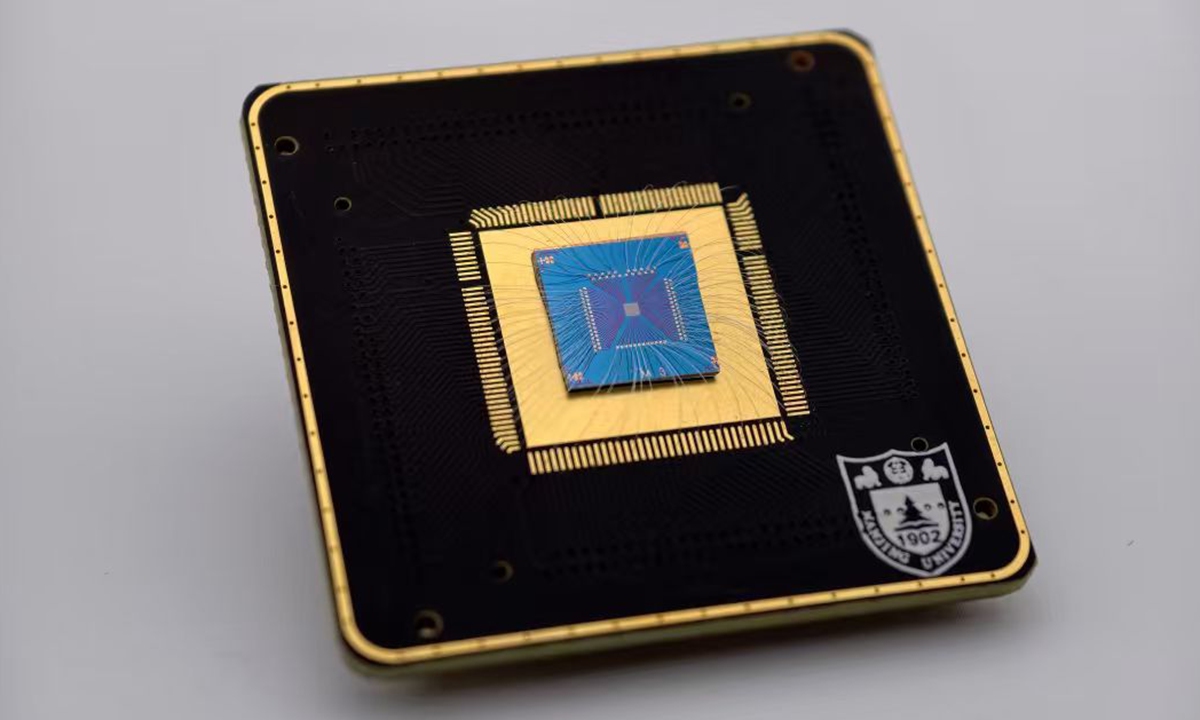
A Chinese research team from Nanjing University has developed a new ultra-low-power intelligent vision sensor chip, dubbed "LightTok," that can convert light signals into tokens within the sensor, significantly reducing the high energy consumption caused by frequent transfers of massive amounts of redundant data, the principal investigator told the Global Times.
According to a release from the Institute of Brain-Inspired Intelligence of Nanjing University, tokens generated by the LightTok chip can be directly fed into a Transformer encoder for image recognition.
"Our design idea was to move token generation onto the sensor itself, allowing the chip to directly produce tokens that AI models can process once light reaches the sensor," Miao Feng, director of the Institute of Brain-Inspired Intelligence at Nanjing University, told the Global Times on Thursday. "These tokens contain complete image information."
Physical AI refers to intelligent systems capable of autonomously perceiving, reasoning, acting and receiving feedback in the real world, representing a key pathway for AI to move from the digital realm into the physical world. Vision-based physical AI systems powered by large AI models need to convert visual information from real-world environments into tokens that can be processed by AI models before feeding these tokens into Transformers for subsequent tasks.
In traditional visual perception pipelines, light signals must go through multiple stages, including image sensing, analog-to-digital conversion, data buffering and transfer, digital image patching and embedding, before being transformed into tokens that AI models can process. The frequent transfer of massive amounts of redundant data has resulted in high energy consumption at the edge, according to a report by Science and Technology Daily.
The LightTok chip directly addresses a key challenge in physical AI hardware: how to efficiently acquire and tokenize visual information from the physical world with low energy consumption, Miao said.
The LightTok chip consists of a photosensitive memory array and peripheral circuits. The team built the array based on single-layer molybdenum disulfide (MoS₂) floating-gate phototransistors, with each pixel capable of sensing light, storing information and performing analog computing. By processing optical information directly within the chip, the device can convert captured visual signals into tokens for AI models, according to the research team.
The current LightTok prototype has a resolution of 32×32 pixels, or 1,024 photosensitive pixels, which is still smaller than that of smartphone cameras and industrial imaging systems. However, Miao said the technology is compatible with CMOS manufacturing processes and can be scaled up. With wafer-level growth of molybdenum disulfide materials, the chip could potentially achieve a scale comparable to existing imaging devices.
Miao said the chip also draws inspiration from the information-processing mechanism of human vision. Similar to how the retina extracts key visual information before transmitting it to the brain, the chip also aims to process visual information at an early stage.
The research was conducted in collaboration with another research team from the National University of Singapore. The findings were published on Wednesday in Nature Sensors, an internationally renowned journal in the field of sensing technology, according to the release.
Potential applications for LightTok include drone systems, autonomous remote sensing and small-scale embodied AI systems, Miao said. In these scenarios, devices need to continuously detect, understand and track targets, generating massive amounts of visual data. By reducing the energy required for visual processing, the technology could extend the operating time of drones, satellites and small robots with limited power supplies, the expert said.
。
Current article:http://rdd9yaj.cengzaodengchawonin.cyou/otnb/i7pua.html
Published on:00:00:00


哔哩哔哩TXT下载声明:
1 我的网站免费提供的哔哩哔哩,均由网友上传,供下载测试之用,不作商业用途,下载后请二十四小时后删除!
2 我们根据txt小说全文所整理出哔哩哔哩txt电子书全集免费下载,由程序自动生成哔哩哔哩txt下载文件。
3 书友所发表的txt小说哔哩哔哩的相关评论,并不代表本站赞同哔哩哔哩txt下载或者支持哔哩哔哩的读者观点。
4 如果发现小说《哔哩哔哩txt全集》无法下载未及时更新请联系我们。如果您喜欢哔哩哔哩txt电子书,请支持作者到书店购买正版图书。感谢您的合作与支持。
5 好看的小说哔哩哔哩是作者"百年不渡"的最新力作,哔哩哔哩电子书由网友发布;小说哔哩哔哩版权属于作者所有,如果侵犯您的利益,请通知我们。